We Hold These Truths…
Our shared freedom requires continuous testing, transparency, and open debate; legal reforms to meet new circumstances; and active tending to and recognition of injustices, both now and in the past, so we can build a future where all of us thrive.

July 4th is the celebration of our nation’s birth with the signing of the Declaration of Independence from England and King George, whom the British settlers saw as an oppressor of their freedoms and as unjustly benefiting from the abundant resources of the then-colonies. This 250th anniversary year brings understandably and exceptionally celebratory fanfare and events alongside the more traditional parades, fireworks, and family gatherings. Yet our history is complex.
It is true that the United States has grown from those revolutionary ideas of freedom into an exceptional country capable of leading the world. At times we have been and done just that. Yet, from long before our “Independence from Tyranny”, our nation’s foundations were laid with the antithesis of the freedom the Declaration espoused.
On July 5th, 1852, Frederick Douglass questioned it as a day of celebration given the sanctioned oppression of Black people as slaves. In his famous What to the Slave is the Fourth of July?" he said, “For it is not light that is needed, but fire; it is not the gentle shower, but thunder. We need the storm, the whirlwind, and the earthquake. The feeling of the nation must be quickened; the conscience of the nation must be roused; the propriety of the nation must be startled; the hypocrisy of the nation must be exposed; and its crimes against God and man must be proclaimed and denounced.”
Indeed, many believe the founding of the US dates to 1619, with the arrival of the first slaves in Jamestown, Virginia. For Indigenous people, the arrival of European treasure seekers for the Kings and Queens started more than 100 years before that. And along with the arrival of the colonizers began the violent genocide of their people and culture, and the stealing of their lands. President Lincoln’s Gettysburg Address proclaimed “a new birth of freedom” and that “a government of the people, by the people, for the people, shall not perish from the earth.” At its best, this is an aspirational portrayal of the US. A hope for some future time that has yet to arrive even a hundred years after the end of the Civil War.
Some believe the ratification of the 15th Amendment in 1870 was the true birthday of the US, achieving the right to vote for Black men after a massive and bloody war. This accomplishment, an important victory as it was, left over half the nation without that right to vote. It took another 49 years of struggle, organizing, and battles to ratify the 19th Amendment and secure women's right to vote. And many more decades passed before the Voting Rights Act of 1964 was enacted, and the Equal Rights Amendment still has not been ratified.
Whatever the perspective, one date or another, one right or another, the founding of the United States and our ongoing existence is less of a celebration for something accomplished and much more of a mixed-up sense of the possibility of freedom - not actual freedom. After all, who among us has the right to have different views? Who has the right of privacy, and freedom of assembly? Who can express themselves verbally, in peaceful protest or in the voting booth without fear of harassment or harm? The answer, in all cases, is - it depends. It depends on who you are, the color of your skin, your identity, your economic status, maybe the state you are in, or who the President of the US happens to be. But with all the faults and hypocrisy, it has been true since the late 1700s that the US was a beacon of hope for others fighting to free themselves from oppression—the French Revolution in the late 1700s, the uprising in Haiti in the early 1800s to become the first freed colony from a European state, to the ensuing revolutions of South America, Africa and Asia over the later 19th and through the 20th centuries.
How, at the same time, can a beacon of hope for others be darkness and danger? At many times in our nation’s history, and today, the US is leading the world in attacks on civil and human rights that are fundamental to any inclusive, equitable, and just society. Just days before this 4th of July, the Supreme Court reaffirmed the protection of birthright citizenship – but only barely. And in recent times the US Congress and the Supreme Court have: gutted the Voting Rights Act; cut reproductive health care for women; and more often than not turned a blind eye to the President’s overreaching of Executive powers, including restricting free speech, arresting and even killing peaceful protestors, and unleashing marauding masked men to intimidate and incarcerate and deport US citizens, immigrants, and refugees.
Now more than ever, let this day call us to commemorate the diversity of identity, heritage, and perspectives that make this country great, reevaluate the state of our nation, recommit ourselves to protect the sacred rights and freedoms gained through the sacrifices of our forebearers, and acknowledge the need for reparations for past harms. Our shared freedom requires continuous testing, transparency, and open debate; legal reforms to meet new circumstances; and active tending to and recognition of injustices, both now and in the past, so we can build a future where all of us thrive.
At Just Solutions, we are committed to advancing equitable solutions to the climate crisis, and our work is carried by the belief in accountable democratic institutions for and by the people. Representative democracy needs to be more than an idea; it requires active participation—questioning, listening, learning from, and challenging our would-be leaders to ensure they uphold their duties to us. Without active participation, representative democracy erodes and becomes a hollowed-out dream. That’s why we collaborate with our partners to support communities with the information and tools to exercise their democratic rights by asking hard questions about what’s happening with our climate, economies, and communities and demanding accountability from office-seekers. Our latest resource, created with national partners in ClimateMax, A Non-Partisan Field Guide to Connecting the Dots for Candidates & Voters, does just that.
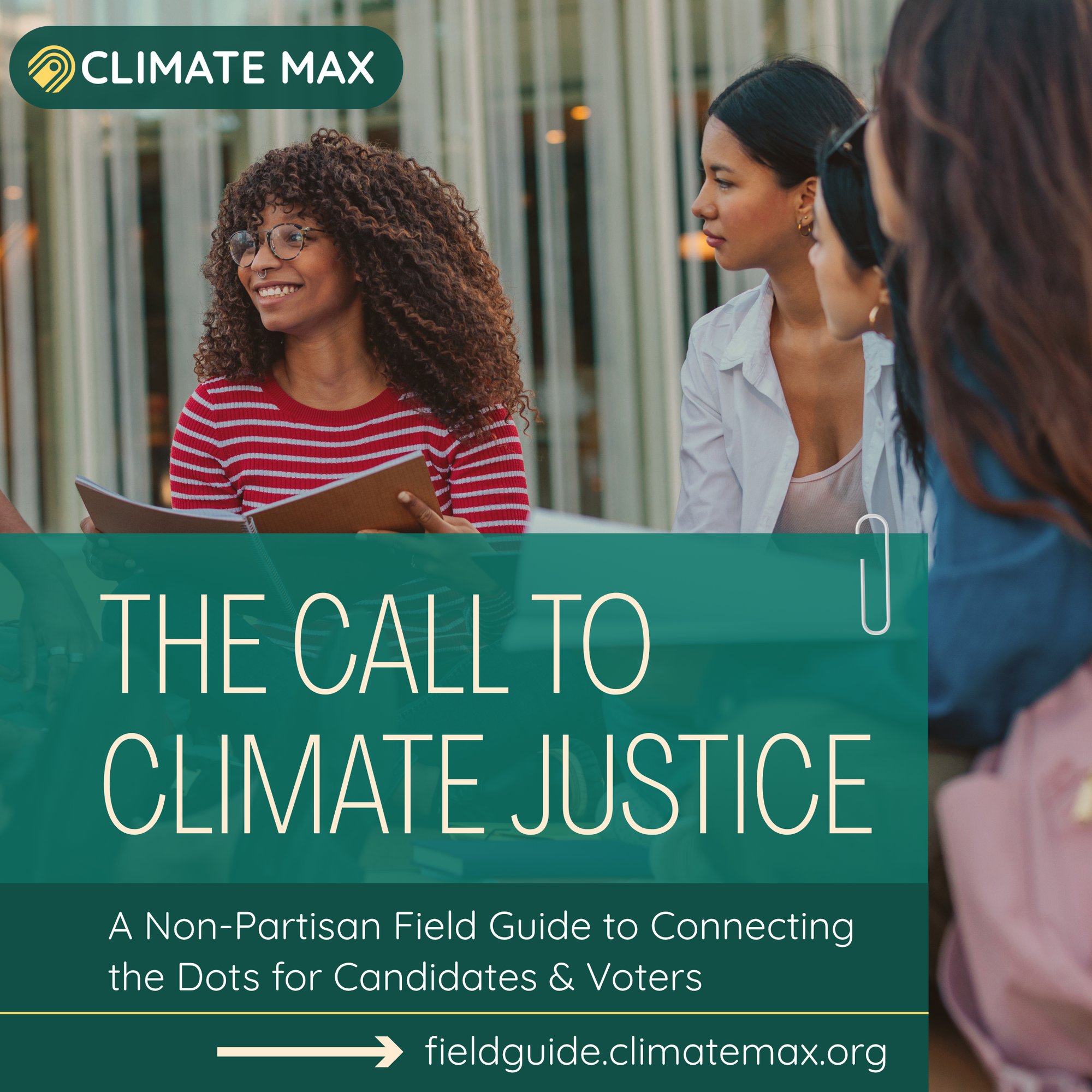
The Field Guide is your go-to resource for finding your candidates and asking questions, with model questions to shape, inform, and drive the conversation with the candidate and others in the room. Use it to talk with office-seekers about what is important to you, what you are concerned about, and what you expect from them. After all, everyone who seeks a job has to be interviewed and questioned. Why should you inquire and require any less from elected officials who control so much? So get out there and ask them where they stand on the issues you care about.
To win on climate justice, it's imperative to stand our ground against the erosion of hard-fought rights for all people to be equally represented in a democracy, and to challenge the attacks on equity. Even though the electoral system is not the only way to drive change, when our voices are barred from the polls, we are even further from reaching the collective prosperity we seek for a just climate future. So test your freedoms.