Leveraging Solar and Wind Variability to Promote Energy Affordability, Democracy, and Resilience
The variability of wind and solar can be an advantage for energy consumers who can turn their power as energy users into savings.

Author: Arjun Makhijani, PhD.
A transition to a decarbonized electricity system with solar and wind as primary sources of supply implies profound changes. A principal underlying technical reason is that primary energy supply will change from mainly switchable generators to ones where supply varies according to the rhythms of the seasons and the daily uncertainties of the weather. In other words, the vast majority of the switches will be in Mother Nature’s hands.
Yet, because solar and wind are lower-cost than fossil fuel and nuclear energy, the energy transition presents a major opportunity to make energy more affordable.
Surprisingly, if approached right, the variability of solar and wind itself could also provide a major opportunity for energy affordability and democracy by giving consumers substantial control of energy bills. The caveat is critical because the opportunity can only be realized with a specific approach to the energy transition. There is more than one way to get to a decarbonized system; the path to a democratized system in which bills are affordable and controllable by consumers is narrow, with a major role for distributed energy resources. That same path can also lead to greater resilience in the face of climate extremes, prolonged electric grid outages, and global energy and economic shocks, such as those triggered by the 2026 U.S.-Israel-Iran war. This paper explains the opportunities and the challenges involved in realizing them.
The Technical and Economic Basis of the Opportunities
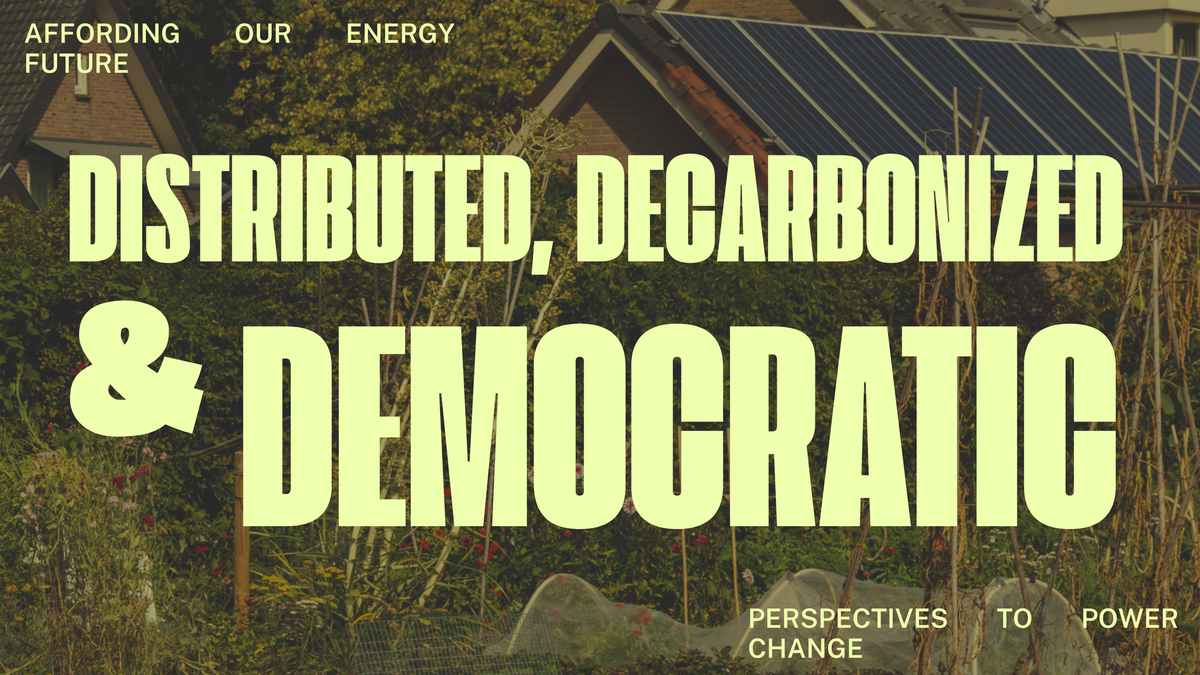
A new affordability opportunity has emerged because solar photovoltaic systems have only modest economies of scale. That means small-scale systems, like residential rooftop solar, can be economically attractive if electricity pricing and grid interconnection conditions are right. For democratization, the main challenges and opportunities are also connected to solar energy. A central challenge is that solar supply is highly variable. Yet that variability, coupled with the fact that it can be deployed on a very small scale on rooftops and balconies, also provides major opportunities for affordability and democratization.
The annual average solar generation from a solar installation is generally in the range of 12 to 25 percent of the system’s maximum output when the sun is directly overhead.[1] There is no generation at night; solar availability is much lower in the winter than in the summer. Cloudy and rainy areas generate less than sunny ones. Wind supply is also very variable.[2] One result is that a decarbonized electricity system in which solar and wind play major roles has frequent gaps between supply and demand, many of them large. There are many hours of the year when the generation greatly exceeds the demand, and many when there is a significant deficit.
This is a technical challenge because electricity supply and demand must be closely balanced at all times. Deviations from balance, which occur when consumers turn switches on and off, must be small relative to system size, and brief, with balance restored rapidly. Large supply surpluses or deficits result in blackouts. The present system maintains electron balance by keeping a certain amount of excess switchable capacity in reserve, usually in the form of gas turbines, some of it as “spinning reserves.” It is like an idling delivery van, ready to move. Peaking generation is expensive because the generators are shut down or idling the vast majority of the time.
A renewable system must meet the same physics imperative of supply-demand balance. But it is a much bigger challenge in solar and wind systems because the natural surpluses and deficits of supply are very frequent and often very large. In a realistic hourly model of a nearly completely electrified Maryland energy system over an entire year, wind and solar supply fully met the demand only about two-thirds of the time – and there were substantial surpluses in many of those hours.[3] Many of the other hours had small deficits, but the supply deficit was large some of the time. This was the case especially on winter nights when the winds were low.
These same surpluses and deficits present a large economic opportunity because consumers can close a significant portion of the gap. How much of it consumers can close will depend on the technical, economic, legislative, and regulatory parameters of the energy transition.
Demand Response and Storage
The value of electricity in hours of deficit is high because a reliable system must fill the gap and fully serve the load. The higher the deficit, the higher the value, since a failure to meet the demand at such times implies a wider blackout. At the same time, during times of surplus, the electricity is essentially free. That is, unless it is used, it would have to be curtailed – the electrical term for throwing it away. Two kinds of technical wizardry can convert the challenge into an economic benefit for households (and businesses). One is to store the surplus electrons, usually in a battery, for later automatic recovery in times of deficit.[4] Batteries enable surplus electrons to be carried forward to times of demand deficit. The second type of investment would reduce the demand deficit by shifting energy use to times of surplus supply either forward or backward in time, usually within the same day. This second approach, called demand response, can enable consumers to reduce their bills without investing in batteries. Both together can be even more advantageous.
Demand response is already familiar in the form of “air-conditioner cycling”; it is offered in many states. For instance, Maryland utilities pay consumers who agree to have their central air conditioners cut off for short periods during peak demand times on the hottest days. The payment is in the form of a bill credit. Investment by the consumer is not required because the utility installs the necessary radio-operated cut-off switch outside the house. The system could be made more appealing to more consumers, for instance, by allowing credits for pre-cooling the home by a couple of degrees in anticipation of a peak load in the late afternoon. This option would require a programmable thermostat.[5]
Air-conditioner cycling is a demand response opportunity for a very limited number of hours, perhaps a dozen days a year, when utilities use it to cycle the air-conditioners to reduce peak load. The practice can be extended to electric water heating and space heating. Electric vehicles present an opportunity for shifting charging times. With the right equipment, they can also supply electricity to the grid–a technology known as “vehicle-to-grid” or V2G. In effect, V2G combines storage and demand shifting.
The opportunities for demand response and storage also greatly increase as solar and wind provide greater shares of supply. This is simply because there are more supply-demand gaps to fill and many more supply surpluses to fill them with.
Taken together, electrification of household energy and transportation using solar and wind as supply mainstays can provide the basis for consumers to get a significant share of electricity system revenues. Consumers become producers as well, hence the new term: “prosumers.” Demand response improves affordability by better aligning electricity system economics with the rhythms of nature.
Energy Democracy, Affordability, and Distributed Resource Aggregation
Demand response and other distributed resources can provide individual control of energy bills, enhancing affordability and democracy at the same time. Aggregation of distributed resources can further expand affordability and democracy. Today, utilities that offer air-conditioner cycling currently aggregate the demand reduction by simultaneously sending signals to subscribers’ air conditioners at peak-demand times. An array of distributed resources can be aggregated in this way. And utilities do not have to be the aggregators. Instead of utilities, third parties can aggregate consumer-supplied distributed resources.Third-party aggregators today are generally for-profit businesses that are independent of utilities.[6] But the third parties could also be public entities, like municipalities and counties, or cooperatives owned by subscribers. Such third-party aggregators could reduce cost for consumers because some of the profit that now goes to investor-owned utilities (IOUs) would either be eliminated or go to subscriber households and businesses. Demand response aggregation can also reduce the overall cost of electricity by avoiding costly investments in additional generation capacity to meet peak demand.
It has proved difficult and expensive for communities to try to wrest control of IOUs by purchasing all or part of their assets, for instance, by municipalizing distribution assets, like poles, wires, substations, and local power plants. The reason is not hard to identify. Regulated utilities generally get a very attractive rate of return; 10 percent on undepreciated assets is common. They are loath to give it up.[7]
Cooperative or municipal third-party aggregation provides the opportunity to expand energy democracy and affordability without the complexity of acquiring existing corporate-owned assets. The concept is essentially the same as “community choice aggregation” (CCA), which is already widespread across the United States. CCA is, in essence, demand aggregation. Counties and cities
acquire wholesale electricity on behalf of their residents to lower costs, reduce carbon emissions, or both. Residents can opt out of this third-party aggregated supply and remain on the utility supply.[8]
Visioning a More Distributed, Decarbonized Energy System
The energy transition is usually conceptualized as an electricity system that uses a mix of large-scale low-carbon resources, including large-scale solar and wind farms, nuclear power plants, fossil fuel resources with carbon capture and sequestration (CCS), geothermal power plants, and existing hydropower resources. Leaving aside the economically and environmentally problematic aspects of nuclear power and fossil fuel plants with CCS, such modeling omits a major role for distributed resources that are integrated into the decarbonization strategy.
Beyond affordability and energy democracy, the centralized approach fails to integrate increased resilience, which is needed to maintain an uninterrupted power supply to critical community loads during outages. Distributed resources, notably solar and storage, are central to achieving decarbonization with resilience.[9] Specifically, long outages impose extraordinary costs on communities, especially on low- and moderate-income households, who cannot afford to eat out frequently, stay in hotels, or easily replace spoiled food.[10] Integrating increased resilience by ensuring uninterrupted electricity supply to critical loads with decarbonization is therefore also an aspect of affordability.
Distributed solar, storage, demand response, electrification of heating and transportation, and using the latter for V2G can also greatly mitigate the economic disruptions caused by global shocks occasioned by energy-related wars or other supply disruptions (of which the 1973 Arab oil embargo remains a prime example). The value of such resilience becomes greater in a more uncertain world. A high fraction of supply from distributed resources can create a system that is not only economical on a routine basis, but also resistant to a variety of natural and man-made upheavals.
Investment, Regulatory, and Legislative Aspects
Distributed resource technologies have advanced to a stage in which they can play a role on a par with large-scale generation, like coal, gas, or nuclear plants. This reality was recognized by the Federal Energy Regulatory Commission (FERC) in 2020 when it issued FERC Order 2222.[11] It instructs regional transmission operators to accept aggregated distributed resources, including distributed generation, distributed storage, and demand response, on a par with large-scale generation. FERC Order 2222 allows third-party and utility aggregation. But it also gave states the option of banning third-party aggregation;12 states have partial or full bans. In the future, FERC may prohibit states from enacting such bans.[12]
Creating distributed resources needs infrastructure investment. As noted, air-conditioner cycling requires radio-controlled switches or programmable thermostats. Electric space and water heating would need to be similarly equipped. Efficiency incentives can be coupled with demand response. For instance, incentives for heat pump water heaters in California require enrollment in demand response.[13] Widespread demand response aggregation would be facilitated by universal broadband access. Appropriate chargers are needed for V2G. EVs must be equipped with inverters to supply household loads directly when plugged into an outlet (known as “vehicle-to-load” or V2L). These investments can be made by non-utility parties, who also reap the economic benefits.
Owner-occupied low- and moderate-income households may have only some of the financial resources needed to make these investments. Some combination of grants and low- or zero-interest loans is needed in these cases. The investments must ensure that the overall electricity bill is lower than it would be without them. In addition, the loan repayment and electricity charges should be consolidated into a single utility bill that is guaranteed, within the parameters of the investments, to lower electricity bills. These are all aspects of state-level regulation.
Renter households can also participate in demand response. As is true for other aspects of clean energy investment, such as improving insulation, investments often require landlord permission and/or participation. This runs into the well-known “split incentive” problem, because the vast majority of
renters pay their utility bills; they would benefit from reduced bills. But landlords bear the cost of the investments and thus have no incentive to make them. Remedying the split incentive problem usually requires financial incentives for landlords. But it also requires broader reform. For instance, the many non-energy benefits of improved energy affordability (such as better health) need to be integrated into the ratemaking process.[14]
Revenue Sharing
Stepping back from the details, the main issue is the structure of future supply and demand. What fraction will be distributed resources? How much will be supplied in the form of distributed resources (including aggregated demand response)? Who will own and control the distributed resources? Who will aggregate them? At what rates will consumers and third-party aggregators be compensated? The answers to these questions will determine the partition of revenues between utilities and consumers. IOUs can look forward to higher profits should resources continue to be primarily centralized and owned by them. Essentially, all present electricity system revenues go to utilities. Almost 80 percent go to IOUs; the rest go to publicly-owned utilities and cooperatives.[15] With substantial investments in distributed solar, distributed storage, and demand response, along with appropriate regulations and policies, a large fraction of electricity system revenues–potentially onefourth or more–can flow to consumers, municipalities, and cooperatives.[16]
The average annual household electricity bill in 2024 was about $1,700.[17] It varies regionally. Bills are higher when space heating is electrified (as will be true for almost all houses in a decarbonized electrified future); lower when it is not. When household heating and road transportation are completely and efficiently electrified, the annual cost of electricity would increase in the range of $3,000 to $4,000 a year at current rates, other things being equal (that is, without uneconomical investments in nuclear power and fossil fuel generation with CCS). Of course, electrification would eliminate natural gas and gasoline costs.
Conclusion
Solar and wind electricity are the most economical approaches to decarbonization; they are cheaper than fossil fuels with carbon capture or nuclear power. The variability of solar with the seasons and daily weather presents challenges in closely matching supply and demand at all times, a technical necessity, because there would be frequent surpluses of supply and also many significant deficits. Yet, that same variability can be turned into a major opportunity for affordability and energy democracy via widespread adoption of demand response, complemented by investments in V2G, and distributed energy storage and solar generation. Consumers can become producers in a major way, and thus obtain a significant share of electricity system revenues. Cooperatives, counties, and municipalities can aggregate distributed resources, thereby furthering energy democracy while reducing cost.
Seizing these opportunities requires integrating distributed resource investments with overall decarbonization planning. This is necessary, in any case, to increase resilience in the electricity system. Today’s demand response opportunities are very limited; they can reduce bills by at most a few percent. That fraction can increase greatly in an appropriately structured future renewable system. That will mean a lower revenue share for utilities. Investor-owned utilities, which control 80 percent of the electricity market, are unlikely to cede a significant share of revenues in the absence of policies, regulations, and legislation. Communities and states will need to create their own plans and enact and implement them to achieve an affordable, resilient, and zero-emissions energy future that is also largely shielded from global energy shocks.
This essay is an excerpt of our anthology, "Affording Our Energy Future: Perspectives to Power Change." To read the full body of work, visit our website.
The ratio of annual average generation to the capacity multiplied by the hours in the year is called "capacity factor" ↩︎
Wind energy is economical and has higher capacity factors than solar when the turbines are large (typically a megawatt or more per turbine). Wind power does not scale down as well as solar. Residential-scale wind systems are generally more expensive than comparably sized solar; they are often used in off-grid applications or for mechanical energy to directly power irrigation pumps. Alessandro Bianchini et al. (2022). Current status and grand challenges for small wind turbine technology, Wind Energy Science, Vol. 7. ↩︎
Arjun Makhijani (2016). Prosperous, Renewable Maryland. Institute for Energy and Environmental Research. Adding batteries and demand response enabled the entire load to be served for 98 percent of the hours. The rest was served by peaking generation using fuel cells powered by hydrogen made using renewable electricity that would otherwise be curtailed. ↩︎
The electricity can also be stored as coldness, for instance in ice, or heat, for instance as hot water, for seasonal or diurnal thermal storage. ↩︎
See, for instance, Pepco DC Energy Wise RewardsTM Program. Viewed on November 24, 2025. Consumers can choose a utilityprovided smart thermostat instead of a radiocontrolled switch for the cycling program. ↩︎
There are many such third-party aggregators in California. The California Energy Commission has compiled a list (viewed on January 15, 2026). ↩︎
For example, in Boulder, Colorado, residents voted to municipalize their electricity system (owned by Xcel Energy), but failed after 10 years of effort, when they voted to remain with Xcel, conditioned, among other things, on the utility meeting climate targets. The issue was again politically a live one in 2025, in part because of a shortfall in meeting decarbonization targets. Amber Carlson, Boulder Reporting Lab, April 20, 2025. ↩︎
Community Choice Aggregation is particularly widespread in California. See the FAQs provided by the California Public Utilities Commission. ↩︎
For examples of uninterrupted power supply for essential community loads, see Arjun Makhijani, Shay Banton, and Jeffrey Marqusee (2024). Storing Electrons: An Analysis of the Role of Long-Duration Energy Storage in a Decarbonized, Economical, Equitable, Resilient Electricity System. Chapter 5. ↩︎
Elena Krieger et al. (2025). Affording Our Clean Energy Future: Pathways for Action. Just Solutions. October. ↩︎
Federal Energy Regulatory Commission. (2020.) Participation of Distributed Energy Resource Aggregations in Markets Operated by Regional Transmission Organizations and Independent System Operators, FERC Order 2222. September 17. ↩︎
Microgrid Knowledge. (2023) Demand Response Aggregation Bans Partially Lifted in 2 States; 10 More to Go. Microgrids, DERs Benefit. October 27. ↩︎
The program also requires enrollment in timeof-use rates. The process is described here. Viewed on 2026-01-15. ↩︎
Elena Krieger et al. (2025). Affording Our Clean Energy Future: Pathways for Action. Just Solutions. October. ↩︎
IOU electricity revenues were $403.4 billion in 2024 (Edison Electric Institute) out of a total including all providers of $514 billion (Energy Information Administration). ↩︎
The fraction of revenues that non-utility entities, including consumers, could get depends on a large number of variables, including the amount and ownership of distributed solar and storage, demand response
participation, extent of V2G, and rates of compensation for aggregated distributed resources. It could be large. The total electricity storage in a fully electrified road transportation system alone could be the same order of
magnitude as the average daily electricity load in the future (assuming a 100% increase in annual load and 100 kWh battery capacity per vehicle). An analysis of critical loads (such as hospitals, grocery stores, emergency response facilities, medical devices, and shelters) indicates that the needed resources correspond to about one-fourth of the residential and commercial electricity load, apart from electrified transportation. Uninterrupted supply to these loads during grid outages means that they would need to be served by distributed solar and storage. (See chapters 4 and 5 of Arjun Makhijani, Shay Banton, and Jeffrey Marqusee (2024). Storing Electrons.) On this basis, one-fourth or more of electricity system revenues could be obtained by non-utility parties, including consumers, provided rate structures are favorable, and a majority of distributed resources are owned by non-utility parties. That fraction could increase significantly if V2G is generalized. Thermal storage also has significant potential to increase the non-utility revenue fraction. ↩︎Energy Information Administration, 2024 Average Monthly Bill - Residential. Viewed on 2026-01-15 ↩︎