The Resilience Shift in Affordable Energy
Energy affordability is a multi-level crisis that requires addressing systemic costs equitably through adoption of grid resilience standards and strategies, starting with the most climate-vulnerable and energy-burdened communities.

Author: Lew Daly
A Crisis With Roots in an Uncertain Future
Energy affordability is generally viewed as an issue individual households face as they struggle with rising utility bills, but it’s often unclear how rising bills are connected with other energy costs—systemic and collective (social) costs—which are not regulated or controlled in the same way that electricity prices are. How we address the sharp rise in energy system costs suggests the need for a transformative shift not only in how we regulate (and limit) basic energy costs but in how we decide upon appropriate goals and means for ensuring a more affordable energy future—and a future that’s more affordable not in spite of, but precisely because of, addressing climate change.
The destructive impacts of climate change are already part of any crisis of affordability that households face. To keep costs down, we have to set new standards for, and equalize access to, energy protection and recovery as disasters mount and the cascading effects of more frequent large-scale outages threaten to alter the fabric of our society. The most critical basic question is how energy resilience for communities is linked to energy affordability for households as overall system costs rise.
With energy resilience, the focus turns to withstanding, absorbing, and recovering from systemic shocks; and if affordability and resilience are not only linked but on something of a collision course—as is suggested in much new data—so, too, should individual and community energy needs be linked as a matter of policy. Especially for the least well off, achieving affordability depends on a better-designed, more equitable system equipped to limit the impacts of climate change. Transformative change then starts with the question of how energy affordability depends on, and can be enabled by, energy resilience investments in the most climate-vulnerable places.
Affordability Colliding with Climate Change
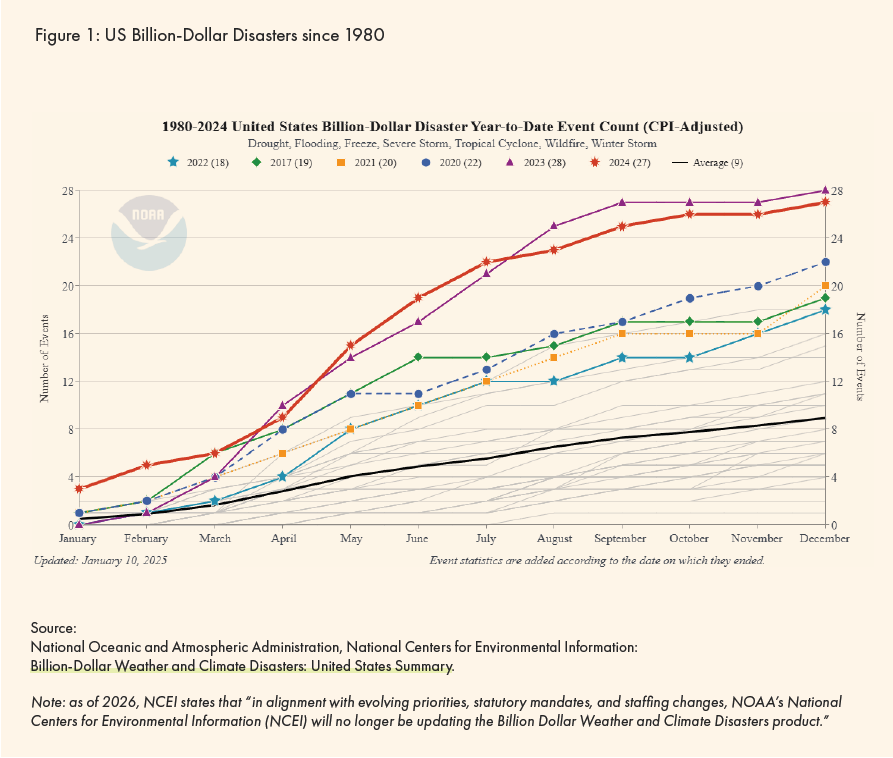
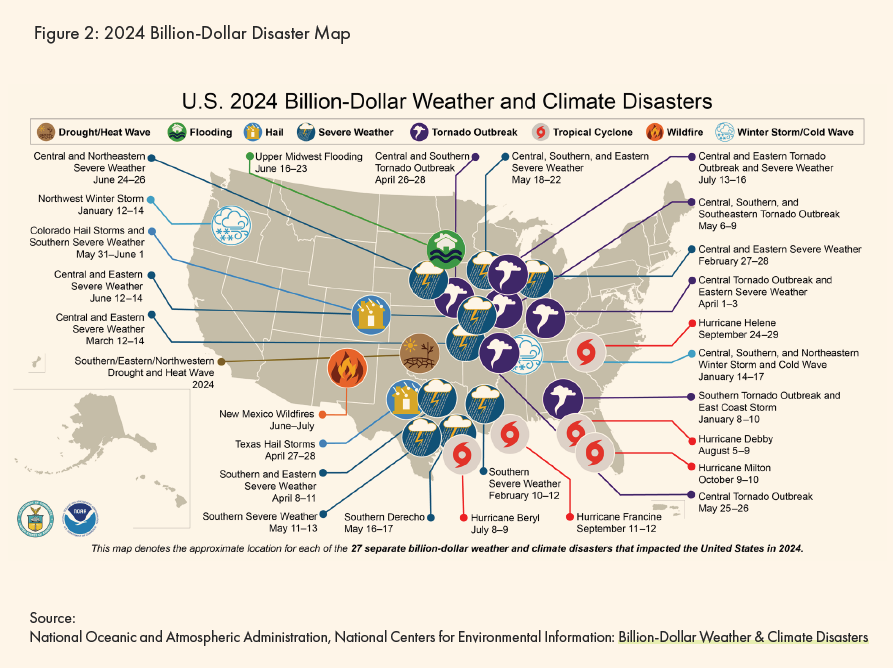
In looking toward a better energy future, certain patterns already increasingly clear in the data should give us pause. As seen in Figure 1, disasters costing at least $1 billion in damages have been piling up in recent years. Between 1980 and 2024 in the US and territories, the six most hazardous years by number of billion-dollar disasters have occurred since 2017, including 28 hurricanes that caused more than $800 billion in damages and thousands of fatalities. In 2024 (Figure 2), there were 27 billion-dollar disasters—including hurricanes Milton and Helene—as compared to an average of only nine per year since 1980.
Federally calculated disaster costs are divided roughly equally between physical property damage (buildings, vehicles, public infrastructure) and power outage cost impacts such as commercial time loss and hotel costs, which averaged about $67 billion annually between 2018 and 2024, when power outage costs rose to more than $120 billion. However, these estimates do not account for physical- and mental health-related costs or other potentially long-term costs related to population displacement. The adverse health impacts of disasters, in large part due to power outages, include carbon monoxide poisoning (from toxic backup heat and power sources), medical needs stemming from inoperable home health equipment, and medical prescription interruptions, among other things. Hurricane Maria’s destruction of Puerto Rico’s electricity grid in 2017 put a spotlight on the health and mortality impacts of long-term power outages, with resulting direct health stressors and barriers to medical attention disproportionately affecting less healthy and under-resourced populations.
Disaster Disparities
Home energy burden, as measured by the percentage of household income spent on electricity, heating, and cooling, is naturally a focal point in the energy affordability debate. But energy burden and climate vulnerability often go hand in hand for the same people: States where low-income households bear the highest energy burdens also rank high for cumulative power outage impacts in recent decades. For example, between 2003 and 2023, severe weather-related power outages in the Gulf South states affected approximately 44 million customers. The average home energy burden for low-income households (<60% of area median income) in these states is approximately 10%, compared to a national average of about 3% for all households (and a standard threshold of 6% percent for being counted as energy-burdened). These same climate-vulnerable states were also home to tens of millions of people reporting, at one point in 2024, that they couldn’t pay an energy bill (~27%), had difficulty paying for usual household expenses (~43.4%), or faced eviction or foreclosure (~29%).
In many disasters, the distribution of power outages reflects disparities in grid resilience by race and ethnicity. During Winter Storm Uri in 2021, satellite data of street lamp outages show that majority-minority census blocks in the storm were 1.5-to-3.3 times more likely to have lost power than majority-white census blocks, while the presence of critical facilities such as hospitals and police stations correlated with only a 16% reduction in outage occurrence and could not otherwise explain the blackout disparities. Climate-related hazard risk has also been linked with longer-term trends such as growing inequality, as recurring disasters reinforce and compound the racial wealth gap through disparate impacts of property damage, population displacement, inequitable recovery aid, and rising insurance premiums or limitations of coverage.
Fighting Climate Change Actually Brings New Grid Threats
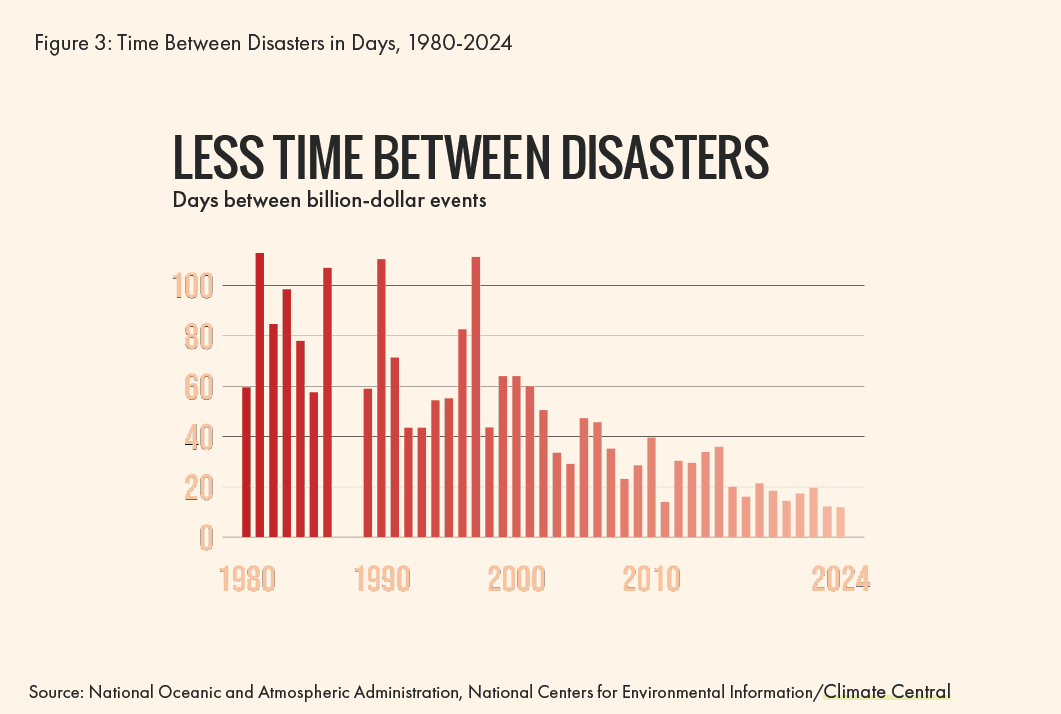
The climate blackouts of recent years likely add up to only a fraction of the challenges we will face in the future. As seen in Figure 3, disaster intermittency dropped to an average of 12 days in 2024, as compared to roughly 80 days in the early 1980s. Thus, disaster recovery effectiveness could itself be increasingly compromised as recovery and rebuilding timelines shrink and public assistance is increasingly spread thin.
But even more concerning, if less well understood, is the fact that meeting the challenges of climate change will make the energy system itself more climate-vulnerable. As the scale and complexity of the energy system evolve with load growth, short of a dramatic pivot toward a more distributed energy system, more energy infrastructure will be potentially exposed to the impacts of climate change. Further, with economy-wide electrification as a goal, our society will have more dependency on the grid for basic needs such as heating and mobility, as well as for many industrial and agricultural activities. In this light, any path forward for the energy system that does not prioritize grid resilience will only increase climate vulnerability in our society, even as we may be making progress in decarbonizing the energy grid.
Affordability and Grid Development in Utility Spending
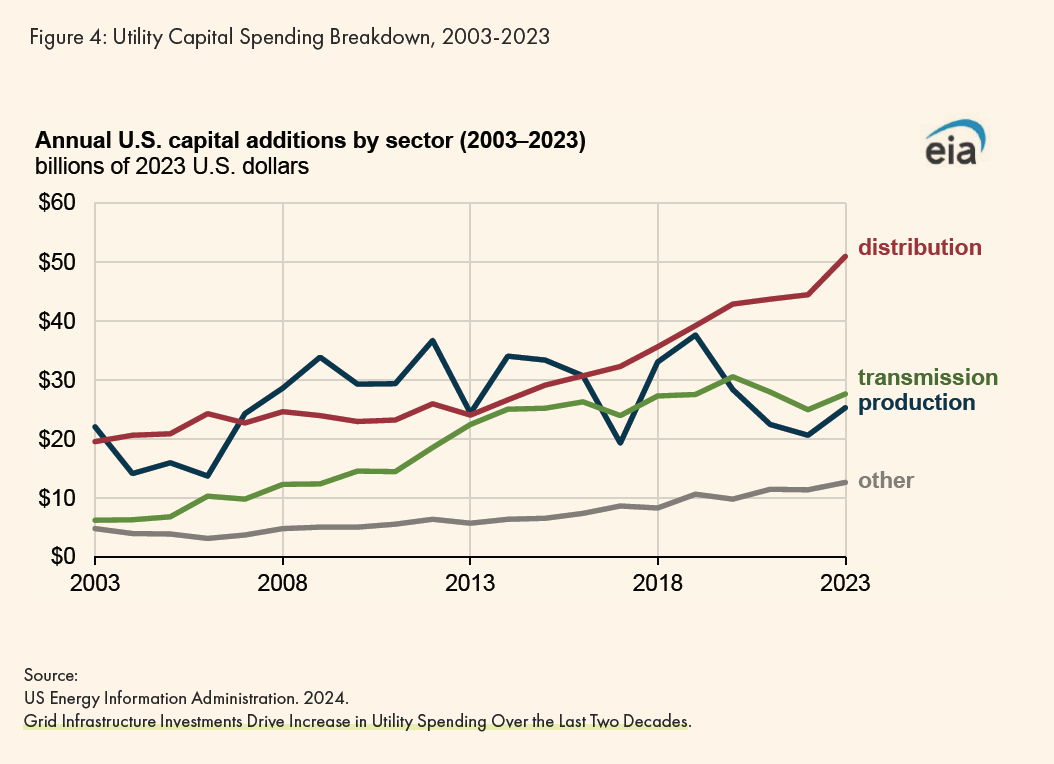
For ratepayers, the growing nexus of affordability and resilience challenges is evident in the trend data on utility spending. As we can see in Figure 4, whereas capital spending on electricity production fell by 24% between 2003 and 2023, capital spending on distribution grids—which harbor the lion’s share of climate-related energy resiliency risk, historic damages, and likely future threats and impacts—rose by 160% over the same period.
Between 2019 and 2023, combined operations & maintenance and capital spending on production shrank while distribution spending rose by more than 20% for operations & maintenance and by roughly 50% for capital costs. Why are these data points telling? Because:
- Under the traditional “cost-of-service” utility business model, electricity rates are directly tied to utility spending in the form of an authorized “revenue requirement,” and
- Distribution grid upgrades, increasingly targeted for energy resilience needs, have become a major driver of utility spending growth in recent years and this may be a continuing trend. In a nutshell, electricity is becoming less affordable because, in no small part, the costs—and risks—of climate change are driving prices up.
The Resilience Shift in Affordability
The once-distant and now recurring threat of major power disruptions brings additional urgency to addressing an energy affordability crisis that will only worsen as disaster costs mount. As the inequitable track record of disaster protection and recovery clearly shows, climate risks in the energy system pose the greatest threat to the very households already most energy-burdened.
Meeting such challenges requires new thinking that links energy affordability with climate protection by fostering grid resilience for communities, defined as the effectiveness of the grid in preventing, absorbing/managing, or quickly recovering from power outages caused by climate-fueled disasters and potentially other disruptive events.
It’s important to put this in context, where, traditionally, utility regulation has revolved around two primary goals: universal access and reliability of service. We have largely achieved universal access in terms of the reach of energy infrastructure and service, but now we must turn our attention toward maintaining the reliability of a system that can only continue to be reliable if it becomes more resilient.
What this means today is that resilience, like reliability and universal access in the past, must be treated—in concept, in value, in planning, and ultimately in law and policy—as a basic, nondiscretionary good. In terms of execution, we also have to recognize that climate impacts in the energy system are highly variable by factors of frequency, intensity, and range, and so, at the human and social scale of climate reality, resilience will need to be adapted to different communities as shaped by their specific needs and vulnerabilities. Ultimately, however, we have to strive for energy resilience on a scale commensurate with the added risks that climate change may bring, and this has to start in the places where climate change poses the greatest risks to the least well-off people.
Utilities’ Role in Energy Resilience
We must re-conceptualize energy affordability as a crisis not only for ratepayers and households, but for the communities where the most vulnerable people live. We must incorporate resilience goals in utility resource planning, including measurement and valuation of resilience for investment and cost distribution, as well as performance accountability. There is not enough space here for even a basic overview of the challenges involved in measuring and valuing energy resilience. Just to define resilience, to set the parameters for what we then need to measure, can be complicated by, among other things, distinguishing outage “prevention” from outage “recovery,” with the former entailing much greater costs (and potential liability) as compared to the latter. Either way, on a per kilowatt hour basis, the cost of power outages greatly exceeds the price of electricity, which means that the value of resilience should rise as disaster risks mount. But utility resource planning is typically based on considering future demand, changing supply, technological change, etc., rather than assessing the highly uncertain but potentially massive risks and impacts of climate change. So, even starting to define resilience and account for its costs and benefits for regulatory purposes presents many challenges. Some utilities, such as ComEd and Ameren in Illinois, have adopted performance incentive mechanisms (PIMs) that reward or penalize the utility based on alternative metrics that better track resilience in grid design and operations for environmental justice communities. But the goal of such resilience PIMs is typically limited to identifying reliability issues that may not be captured in conventional measures and might warrant specific maintenance or capital investment changes to prevent further or broader reliability problems in the future. This is a welcome step forward for improving reliability and potentially fixing equity gaps in day-to-day service. But it falls well short of equitably ensuring grid preparedness for potentially prolonged and deadly disruptions caused by major events.
For advocates and policymakers, a particularly thorny challenge arises with the question of who among energy stakeholders is responsible for energy resilience? Much of the upward trend in electric utility capital spending discussed above appears to be earmarked for resilience investments such as undergrounding or otherwise “hardening” of electricity delivery circuits. Yet, the most cost-effective resilience investments, and the most affordable for ratepayers, are likely to involve distributed energy resources (DERs). DERs may not be profitable for utilities, may require utility payments to DER owners, or even hybrid control of distribution assets that might be needed to support operations, say, of a local or larger-area nested microgrid network. What, then, toward fostering energy resilience, should be required of a utility if its customers are better served by distributed solutions that it does not own or control and cannot book in its rate base?
Building Energy Resilience From the Bottom Up
With disasters now making headlines roughly every other week, concerns about grid resilience are neither hard to justify nor easy to ignore in addressing today’s rapidly escalating energy affordability crisis. So I want to conclude these reflections on an aspirational note, by way of example. It’s called the Tribal Energy Resilience and Sovereignty Project (TERAS), and it will serve three tribal communities in Eastern Humboldt County in Northern California—including 2,220 members of the Hoopa Valley, Yurok, and Karuk peoples who live along one of Pacific Gas & Electric’s worst-performing electricity circuits, with over 100 hours of power blackouts annually.
The project is extremely innovative in the distributed energy field, with three nested front-of-meter microgrids designed to create a network of self-sufficient electricity supply for the three member communities along a roughly 26-mile circuit. Essentially, “nested” microgrids work by connecting separate DER systems into a single independent circuit when the main grid goes down. This idea and the TERAS example point to the possibility of creating larger, semi-autonomous area grids by connecting multiple microgrids between several communities or developments, or across a small city or even a larger region.
TERAS is 100% renewable, with a 20MW solar system and battery storage, and with capabilities to not only provide back-up power when the main grid goes down but also to reduce customer utility bills and to generate revenue for the community by exporting excess power to the grid and/or providing load-shifting services to relieve peak demand. Notably, the project is not utility-owned or publicly-owned but rather community-owned and operated by the three member tribes; the innovative governance stands out against a backdrop of long and bitter challenges for tribal sovereignty and survival in the region, with the timber industry, the US Forest Service, and the now-removed Klamath River Dams, among other non-Native forces, historically arrayed against the tribes.
TERAS will cost about $177 million, compared to an estimated $1 billion for conventional hardening of the adjacent, unreliable utility circuit. The project received an $88 million grant from the Grid Resilience and Innovation Partnerships Program of the Department of Energy in 2024; the grant appears to have been rescinded by the Trump Administration in 2025, but its status is currently unresolved. TERAS may also be supported by incentives from Pacific Gas & Electric’s Community Microgrid Enablement Program.
The Horizon for Action is Already Here
TERAS is notable as a largely publicly funded, community-owned alternative to the utility grid, and whether it could be replicable for dozens or hundreds of other highly vulnerable communities is a pressing and pivotal question. But it also leaves open the question of utility obligations to ensure grid resilience in their service areas, especially for customers living on the most vulnerable utility circuits. One step forward could be requiring utilities to conduct in-depth studies of energy resilience needs in their service areas, with critical input from climate-vulnerable communities. This can serve as a basis for community-directed resource planning and capital spending targeted for the most vulnerable people and places. But the likely significant costs of resilience investments at a meaningful scale should not simply be passed through to electricity rates, unless the rate effects can be structured in a highly progressive manner. Hybrid approaches could also be feasible, for example, with a mix of public funding (grants and tax credits), utility incentives or compensation for microgrid exports and grid services, and a risk-reduction premium added from related public funding streams such as carbon pricing or “polluter pays” revenues. Whatever the path forward, we can expect system costs to compound and affordability to worsen without a strategic shift toward resilience in grid development. In this light, what we have to gain from de-risking the grid should be a guiding and motivating question for policymakers and communities alike.
This essay is an excerpt of our anthology, "Affording Our Energy Future: Perspectives to Power Change." To read the full body of work, visit our website.