Bargaining for the Common Good: A Labor Leader’s Lessons for Energy Affordability
Unions, bargaining for the common good, can be a powerful actor and a model for others to organize to reclaim decision-making over energy prices and systems.

Author: Faye Guenther
Workers across the United States are having a hard time making ends meet. And it is getting worse. We are getting squeezed on both ends–for many, wages have been effectively flat for decades, and basic necessities are costing more. This unaffordability crisis is running rampant through every aspect of our lives–healthcare, housing, food, childcare, gas, electricity, and water are more expensive and less accessible. Despite all the bad news, there are solutions.
Labor unions, at our best, are a place where working people can come together and collectively decide to take action to improve their lives. The intentional and coordinated power of people at work can counter the unbridled greed of corporations, wealthy CEOs, and Wall Street.
The first step to harnessing this potential is to believe in the power of regular working people and communities taking collective action. Wealthy CEOs and bankers know this and have vehemently opposed unions for the past century because of the power workers have when they take action for a common goal. Now the allies of the extremely wealthy control the White House, Congress, and the Supreme Court. But if organized and unleashed, the sheer mass of workers and community acting in solidarity can be unstoppable.
Unions need to step up too. To rebuild a new labor movement, we must do two things:
- Organize tens of millions of workers who want a union at work but don’t yet have one, and,
- Use our leverage in collective bargaining to go beyond the traditional fights for better wages and benefits and push for policies and accountability that help working families, for example, to have affordable, safe, and reliable heat, electricity, and water.
The term for this big-picture strategy is “Bargaining for the Common Good.” It leverages our collective voice to effect positive changes in social, economic, climate, and racial justice, community safety, public health, democratic freedom, and election protection, at work AND in our communities. All of these and more are proposals we can make in contract negotiations with employers and in coordination with our communities. And we can make these same demands in the halls of government. By doing this effectively, we will begin to wear away the perverse forces that have created the unaffordability crisis and that drive the extreme income inequalities of our society.
Let me provide some examples to show how bargaining for the common good works. Back in 2010, we were negotiating a new contract for over 10,000 of our grocery store members working at large and small unionized grocery stores in twelve Puget Sound-area counties in Washington state. We had fought for many years to get those employers to agree to provide paid sick days and to significantly boost the pay rate for the lowest-paid workers. They had largely refused, over and over, on both counts. We took our concerns to the public with store-level actions and held a press briefing for reporters where workers explained the impact of low pay and no paid sick days on their lives. We shifted the narrative in mainstream media coverage in columns like this one, “Grocery Store Workers’ Sick Deal,” and started to make headway in certain local policy corners.
In 2011, working side by side in partnership with many others, we organized and got the Seattle City Council to pass Paid Sick Days into law. A couple of years later, together with other community members, we helped pass a citizen initiative to raise the minimum wage and paid sick days in the community of SeaTac, just south of Seattle. Again, our efforts to get the grocery store employers to agree to our proposal for paid sick days and a big boost to the wages of the lowest-paid workers were denied, but we built power between workers and the community, nearly went on a massive strike, and made other gains in our contract.
Then, in 2014, we got the City Council of Seattle to pass a higher minimum wage, not just for grocery store workers but for other industries as well, which to this day remains one of the highest in the nation.
In 2016, we opted to use our energy and collective power to run a statewide ballot measure to achieve those benefits for all workers in the state. In partnership with dozens of other community organizations, we helped pass the initiative by a huge margin.
This was a game-changer. Workers across the state now had a significantly higher minimum wage and paid sick days. And we no longer needed to attempt to bargain for these benefits in contract negotiations. They were the law. This change allowed workers in our union, as well as hundreds of thousands of workers outside our union, to better care for themselves, their families, and the community. After this 2016 success, we, along with a stellar coalition, decided in 2017 to push for a new Paid Family Leave law. Because powerful business interests in the state knew we could run another ballot initiative and win, they decided to negotiate with us in the legislature instead. We passed a best-in-the-nation Paid Family Leave law.
More recently, in October of 2022, Kroger and Albertsons, two of the largest grocery store chains in America, announced their plans to merge. Recognizing that this proposed merger risked the loss of hundreds of thousands of jobs, the closure of hundreds of stores, and higher prices for millions of customers, a handful of UFCW locals immediately announced our opposition. We reached out to the media, informed state and federal regulators, and built a campaign with top-notch communications, research, legal, and action teams. We built a national network of over 100 organizations, including food rights groups, labor unions, farmers, consumer rights groups, and more. And we were dogged, keeping up these efforts, month after month, all the time centering the campaign on workers speaking of the impact that the proposed mega merger would have on them, their stores, and their community.
We ultimately won the day in two separate legal cases – one in federal court in Oregon by the US Federal Trade Commission, and the other by the Washington State Attorney General in King County court. In the end, our scrappy coalition helped block the largest proposed grocery store merger in U.S. history, and a couple of months later, the CEO of Kroger was forced out. This happened not just in the name of workers, but also in the name of food availability and affordability for our communities. As Margaret Mead said, “Never doubt that a small group of thoughtful and committed people can change the world. Indeed, it’s the only thing that ever has.”
In all these examples, from contract fights to union organizing to public policy fights in local city councils and state legislatures, workers taking collective action and speaking out about their experiences with the community and to the media was a way to build a broader movement, push for change, and win.
These same strategies and tactics can be replicated to address rising energy costs in Washington and other states across the nation. While our energy costs are increasing, just one oil company (Exxon Mobil) made over $25 billion in profit in 2025 alone. Oil and gas companies post their profits of tens of billions of dollars while exploiting workers and communities with destructive drilling and refineries. Then the burning of these fuels drives climate change that threatens our homes, health, farms, forests, and economy.
Downstream, families are facing electricity and utility bills that are rising sky-high. How? Utilities are often monopolies whose requests to raise rates by huge amounts are rubber-stamped by state and local commissions. Rate cases, where prices are often set, are limited to official “parties” and outside the public’s visibility. Adding insult to injury, in most states, these companies use the money we pay them in our utility bills to lobby state lawmakers for more power and influence. It’s a perverse cycle of greed feeding greed. And it should and can be outlawed like it was recently in California.
A bargaining for the common good strategy could help disrupt the business model that limits the issues and parties involved and burdens low-income billpayers with higher costs, all for the sake of shareholder benefit. Unions, ratepayers, renters, and homeowners alike, we all have a stake in winning the fight for affordable, reliable, safe energy and deserve transparency and accountability from the corporations that control our access and the price we pay.
There is reason for hope. Taxation without representation fueled the American Revolution 250 years ago, and it can fuel our revolution today. We can choose a path that is lit by the ideals of independence, sustainability, self-determination, and resilience. We won’t get there without organizing and leveraging our power as workers, consumers, and community members, for the larger good.
Our work doesn't have to be limited to the price we pay for energy from large corporations that control our fuel sources. We can also push to restructure our energy system away from fossil fuels and toward sources like wind and solar that are not controlled, owned, mined, or sold. Wind and solar power are renewable and regenerative and should be commonly accessible for all. By bargaining for the common good, we don’t have to make false tradeoffs like reducing fossil fuels in exchange for nuclear power. Nuclear power has its own problems of massive costs, destructive and harmful uranium mining impacts, safety concerns, and the ongoing creation of radioactive waste, for which we have no real plan for how to deal with.
All this can change with a move toward renewable, sustainable energy and high energy efficiency.
Renters are another area where the power of collective organizing for the common good also applies. Renters typically pay utility costs directly. This means the landlord has little to no incentive to invest in the weatherization, efficient windows and appliances, or solar panels that would lower our energy bills and make our homes more climate-friendly. And most renters lack the capital to make these investments themselves. Advocating to create financial means and incentives for renters and landlords to take action that would reduce utility payments and create efficient, sustainable rental units would benefit renters. Union members who pay rent and are subject to the double-digit rate increases would be better off, as would all the other renters in the community who are not unionized workers.
Unless forced to change, the rigged, polluting, and unsustainable system that benefits just those who make money from it will stay the same. Only when working people, our unions, and our communities come together and collectively demand change can we bust the systems of monopoly and greed, and set a course of resilient, local decision-making that improves people's lives and the places we call home. Unions and communities coming together and utilizing bargaining for the common good strategies provide a model for how we can organize to achieve broad-based benefits, whether it’s higher wages, food security, affordable clean energy, or something else.
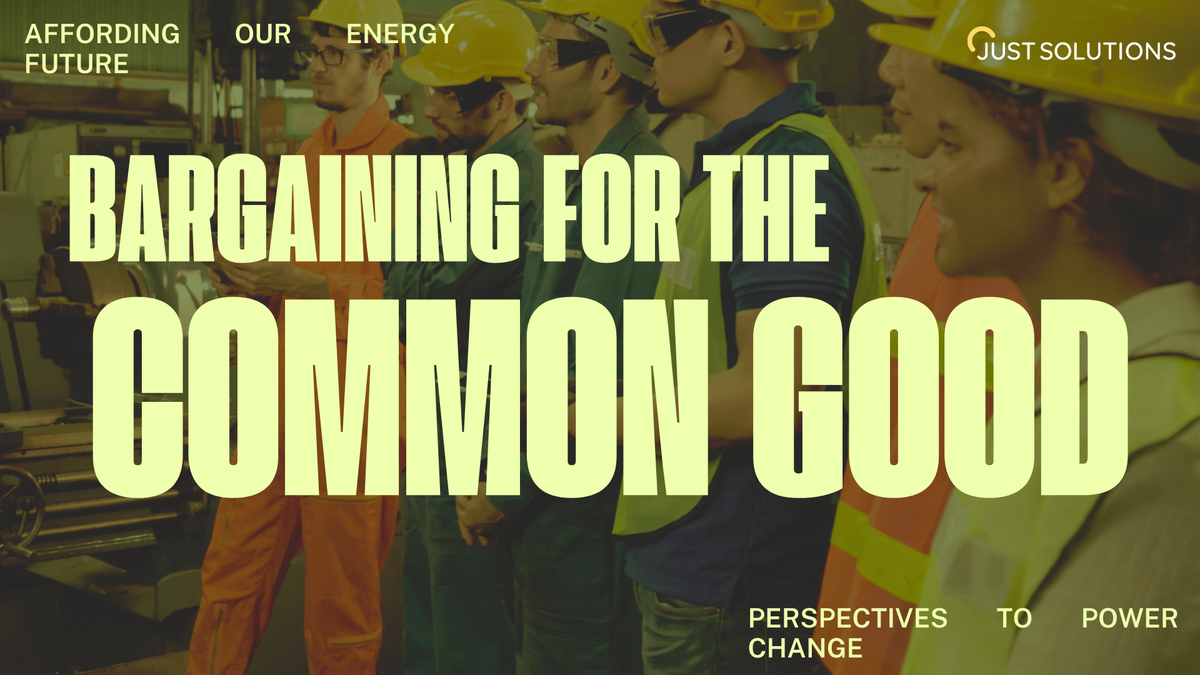
This essay is an excerpt of our anthology, "Affording Our Energy Future: Perspectives to Power Change." To read the full body of work, visit our website.