From Affordability to Shared Prosperity: Reimagining the Energy Transition as Economic Strategy
Energy affordability is not just about the cost of living but also about wealth inequality, racialized exclusion, and institutional mistrust, which require a deliberate strategy toward shared prosperity.

Author: Alvaro Sanchez
Addressing Wealth Inequality and Building Resilience
Across the country, “affordability” has become the dominant frame for understanding public frustration with the economy, yet most of that conversation focuses narrowly on prices rather than on whether people have the resources and power to live stable, dignified lives. When we treat affordability only as a cost problem, we miss the deeper crisis of wealth inequality, racialized exclusion, and institutional mistrust that shape who can weather shocks and who is pushed into precarity with every bill, rate increase, or climate disaster. A mission worthy of this moment must start from a different premise: the goal is not generalized “abundance” for markets, but shared prosperity and resilience for people and places.
This mission is fundamentally about closing the racial wealth gap, accelerating climate action, and strengthening communities so that belonging and economic security are no longer mutually exclusive. It is also about rebuilding public institutions so they are capable of delivering on this promise, particularly for communities that have experienced disinvestment, environmental racism, and extractive economic practices for generations. In California, the Climate Smart Economy Initiative is one expression of this vision: an integrated strategy to align climate goals with broadly shared economic opportunity and community resilience, rather than treating climate policy as a technocratic add-on to an unchanged economic model.
At its core, this vision insists that the energy transition and the economic transition are one and the same, and that affordability can only be secured if households gain real economic power, assets, income, and decision-making power, alongside fair, well-regulated prices.
Economic Development Strategy with an Accompanying Energy Transition Strategy
A mission of shared prosperity and resilience requires an economic development strategy that is explicitly tied to the clean energy transition, not layered on after the fact. For decades, climate policy has been organized primarily around regulation and emissions reductions, leaving economic questions, who gets the jobs, who owns the assets, and which regions gain or lose power, to markets and private actors.
An integrated approach turns this logic on its head. It starts by treating public investment, procurement, and planning as tools to shape markets toward equitable outcomes, in line with Mariana Mazzucato’s call for mission-oriented government that moves from “market fixing” to “market shaping.” In practice, this means:
- Directing clean energy investments toward communities that have endured historic disinvestment, pollution, and climate risk, tying dollars to local hiring, community benefits, and shared ownership structures.
- Using public purchasing power to build regional clean-economy clusters, renewable generation, storage, transmission, building decarbonization, and e-transit, that anchor good jobs, small business opportunities, and community wealth in place.
- Designing industrial and workforce strategies that center workers and communities of color, addressing structural racism in labor markets and environmental decision-making at the same time.
California’s Climate Smart Economy Initiative illustrates this reorientation, calling for economic development institutions with the scale and authority to match climate ambitions and for coordinated strategies that blend public and private capital to build self-sustaining clean-economy industries. This approach recognizes that reducing inequality would strengthen long-run growth by unlocking human potential, stabilizing demand, and expanding entrepreneurship.
Crucially, this is not a call to weaken environmental standards or rush implementation by cutting communities out of decision-making. Instead, it argues for pairing strong climate regulation with robust civic infrastructure and collaborative governance, so that projects move forward with clarity, legitimacy, and shared benefits. Programs like California’s Transformative Climate Communities (TCC) show how this can work: bottom-up planning, multi-sector coalitions, and state support can deliver housing, transit, renewable energy, and green space while building local capacity and shifting power toward residents.
Energy Affordability = Cost Management and Ratepayer Economic Prosperity
In the energy space, affordability debates usually center on rates: how quickly they are rising, who bears which cost, and whether climate mandates are making bills too high. Those questions matter; the price of electricity and gas includes the costs of generation, transmission and distribution, grid maintenance, compliance with climate and equity policies, and returns to investors. These elements must be scrutinized to prevent unjustified profits and inequitable burdens. But focusing on prices alone accepts as given an economy in which many households simply do not have enough income, assets, or bargaining power to absorb even modest rate increases.
A more complete definition of energy affordability has two pillars: rigorous cost management and deliberate strategies to increase ratepayer economic prosperity. On the cost side, regulators and advocates must ensure that:
- Utility investments directly support reliability, decarbonization, and equity outcomes, rather than speculative projects or excessive shareholder returns.
- Climate and clean-energy obligations are implemented in ways that prioritize least-cost, high-impact solutions, including distributed resources, efficiency, and demand flexibility that can reduce long-term system costs.
- Low-income and frontline communities are protected from disproportionate burdens through progressive rate design, targeted bill support, and investments that lower energy use and exposure to extreme heat and pollution.
On the prosperity side, energy and economic development policies must be designed together so that the clean energy transition serves as a platform for building wealth, not just cutting emissions. This means tying utility and infrastructure investments to:
- Local hiring requirements, pre-apprenticeships, and union pathways that put residents into high-quality jobs created by the transition.
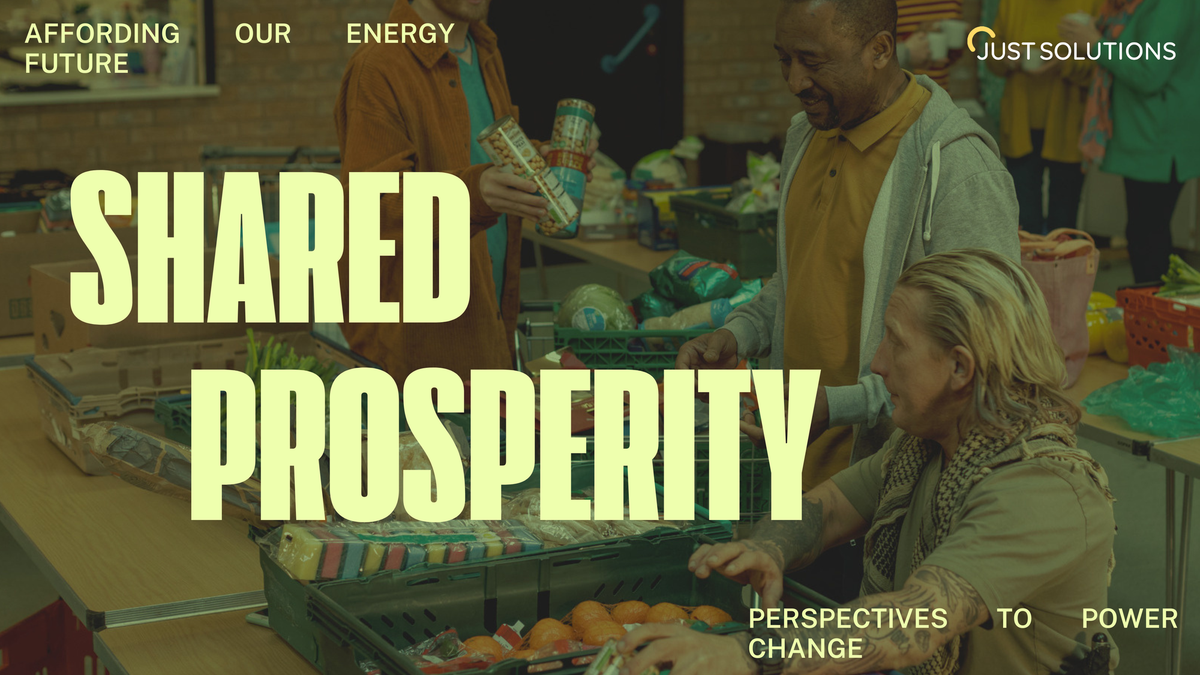
- Community ownership models—such as cooperatives, public power, land trusts, and community solar—so that ratepayers can hold equity stakes in the assets their bills are financing.
- Support for small and community-based businesses that deliver installation, maintenance, and resilience services in their own neighborhoods.
Seen this way, the clean energy transition is also a once-in-a-generation economic development opportunity: the same investments that could raise rates in the short term can also raise incomes, build assets, and stabilize communities, if designed with that mission in mind. When households share in the upside, higher but fair energy prices become more politically and materially sustainable because people can actually afford them and see tangible benefits in their lives.
Government Capacity to Deliver Energy Prosperity
Realizing this integrated vision requires governments that can do more than set rules and distribute grants at the margins; it requires institutions capable of leading a complex, long-term, economy-wide mission. Yet trust in government has eroded, in part because many people experience public agencies as distant, under-resourced, or captured by elite interests, and because decades of austerity have hollowed out the very capacity needed to deliver for communities. Rebuilding trust is therefore both a democratic imperative and a practical prerequisite for shared prosperity.
A new model of government for energy prosperity rests on several shifts. First, governments must embrace a mission-oriented role, explicitly committing to closing the wealth gap, decarbonizing the economy, and strengthening communities, and then organizing institutions, budgets, and partnerships around that mission. Second, it must invest in its own capacity, planning, technical expertise, community engagement, and implementation, so that agencies can move beyond project-by-project administration to strategic, integrated action.
Third, governments must deepen relationships with communities and civil society, recognizing that shared prosperity depends on civic participation and mutual accountability. Local governments, in particular, can evolve by partnering with community-based organizations that are already playing critical roles once held by public institutions, co-creating policies and projects that reflect local knowledge and priorities.
Finally, governments must reject scarcity narratives that pit climate action against affordability and public investment against fiscal responsibility. With the right revenue tools, development institutions, and accountability structures, public investment in a climate-smart economy can both reduce long-term costs and expand the economic pie in ways that are more fairly distributed.
If we align mission, economic strategy, energy policy, and government capacity around shared prosperity and resilience, affordability stops being a zero-sum fight over short-term prices and becomes part of a broader project: ensuring that everyone has the resources, power, and belonging they need to thrive in a decarbonizing world.
This essay is an excerpt of our anthology, "Affording Our Energy Future: Perspectives to Power Change." To read the full body of work, visit our website.