Governing for Energy Affordability and Justice
“If we’re not prepared to govern, we’re not prepared to win.” -Movement Generation

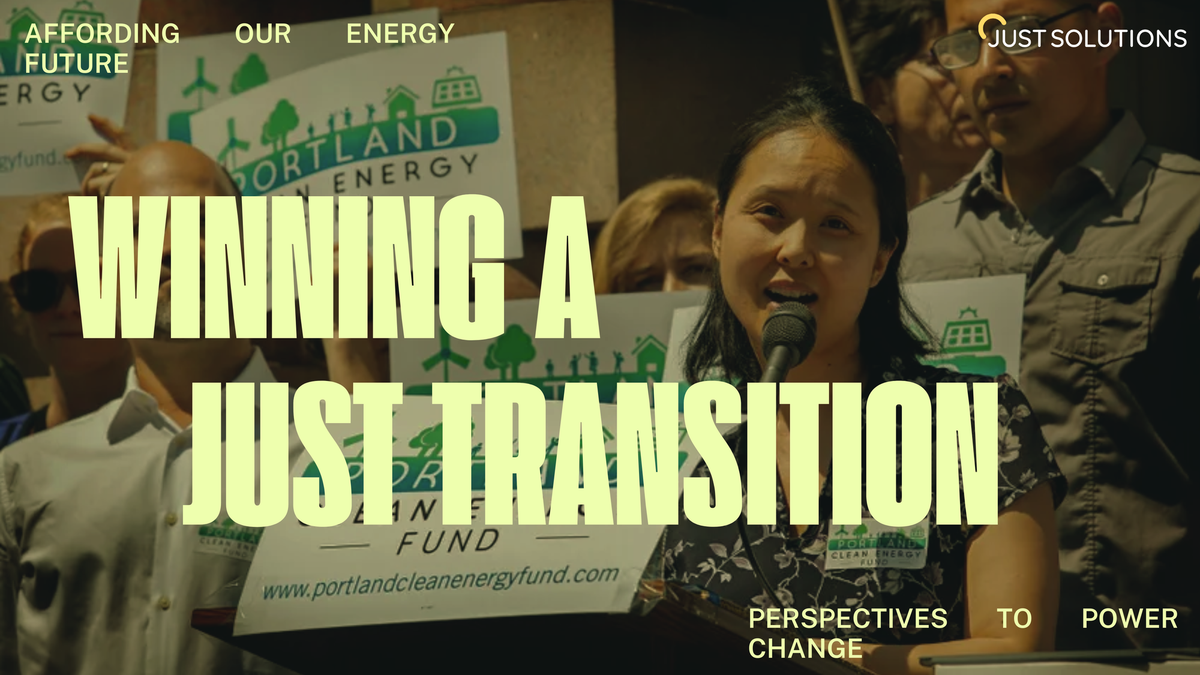
Khanh Pham, Senior Fellow at Just Solutions, speaking with series editor, Deric Gruen
Deric: Khanh, part of governing is leading through narrative. How do you communicate your approach to climate issues and energy as a determinant of affordability, justice, and well-being in the political realm? How do you defend against attacks?
We're at a moment where opponents of clean energy are using rising energy costs as an opportunity to scapegoat and blame our clean energy laws. Oregon has one of the most aggressive clean energy targets in the country, and even though our utility companies have barely started working towards meeting those milestones, which aim to get us to 100% renewable by 2040, those targets are being blamed for rising costs.
The current moment in clean energy politics and energy affordability is very tenuous. While certain fossil fuel interests blame clean energy mandates for rising energy costs, the general public is also starting to connect the rise of data centers, their voracious energy use, and US wars in the Middle East as key drivers of rising energy costs. Elected leaders are, by and large, not experts on climate, and so it is incumbent on clean energy advocates to be able to spread compelling messages and narratives explaining why renewable, distributed, and community-owned power is cheaper, healthier, and more resilient in the face of climate, economic, and political shocks. The current war (as of this printing) underlines that renewable energy is not just good for the climate and public health, it’s also good for global peace and a stable world order.
It's not just about messaging by a few elected leaders or spokespeople. It's a larger cultural project. I heard Bill McKibben recently at a conference, and he paints a really compelling picture and story through anecdotes and actual concrete examples. We need all kinds of leaders and cultural workers, including musicians, poets, and filmmakers, to articulate a clear vision about how the clean energy transition is also a cheaper, healthier, more peaceful, and reliable future.
Deric: What are the key issues you’re facing that really define the struggle right now? What is the larger force you see driving these issues?
Data centers are a real flashpoint across the country right now. They’re often located in rural counties, whose local residents often lack the political power to resist. These data centers are driving up energy costs due to the enormous amounts of energy generation and new transmission infrastructure they require.
The common theme in all of this is the consolidation of corporate power and the ways this concentration of wealth corrupts our political process and government.
During our campaign for the Portland Clean Energy Fund (PCEF) ballot measure initiative in 2018, people really resonated with the idea of holding billion-dollar corporations accountable to pay their fair share (1% of their gross revenue). Only mega-corporations that make over $1 billion in annual sales have to pay, so small businesses and medium-sized local businesses, which we want to support, aren’t impacted. And we use this money to fund clean energy projects prioritizing low-income communities and communities of color.
These questions about how to win a just transition are ultimately about democracy. The questions I constantly ask myself are: Who benefits? And who has to bear the burden? And how do we make sure that the voices of the people most impacted are at the table and ideally are the ones shaping the decisions? It’s usually shareholders and a few mega-corporations who benefit. The people who suffer are the communities living around industrial or nuclear waste sites, as well as their future generations who bear the cost of our insatiable demand for energy.
In a healthy democracy, we’d have a public discussion about whether to invest in artificial intelligence before we let it unleash on the population with very few guardrails. Without AI, we could be focusing on energy efficiency. Our energy demand would be going down, and we wouldn't be reviving all these aging nuclear and coal-powered plants and building new ones.
Yet our elected leaders have, by and large, been passively accepting that these new data centers are the future, whether we like it or not. A lot of people don't even know what AI is, and yet we're already accepting a future in which it eliminates millions of jobs and unleashes massive economic and societal disruption, without being given a chance to make a decision ourselves. Elected leaders and policies haven’t caught up with the pace of technological change, and we’re mostly letting the tech industry regulate itself in the name of economic competitiveness. We have to move beyond this mindset of growth at any cost, towards a vision of resilience, equity, and sufficiency.
Deric: Affordability and clean energy solutions are often wrapped up in broader ideas about scarcity. If scarcity is the problem, then we should focus on supply - to build more stuff. The abundance narrative has popularized this focus on supply-side solutions. Do you think this is where we need to be focused, or is it a distraction from the distributional issues you mentioned?
When I ran on an Oregon Green New Deal platform, which I think is a left version of abundance, I was talking about how we can build tens of thousands of new homes in Oregon, make them green, run them on 100% clean electricity, and create good-paying union jobs building them. That's abundance to me. If we decide that's our goal, we can then work backward to figure out how to get there.
I think there are ways we could paint a picture of equitable, climate-friendly abundance that would be exciting. But it’s a nuanced thing. I support broad permitting and code reforms for housing and renewable energy infrastructure, but it is often conflated with a broader deregulatory approach to shrink government. Abundance for progressives is about trying to strengthen and expand state capacity and show that the state is capable of doing big things, as we did during the New Deal. We can create public entities like the Tennessee Valley Authority, but the time for clean, renewable energy and affordable housing is right now. People don't really believe that government can be a powerful force for good, and we don't have much state capacity. Our government has just been defunded and hamstrung by many well-intentioned processes and policies we’ve passed.
We've made it really hard for people with ideas, passion, and vision to work quickly to address problems. As a legislator, I’m supposed to provide oversight and accountability to state agencies. Now that I'm a Housing committee chair, I'm learning how our building codes–from plumbing to elevators to staircases–have made it much harder and more expensive to build the multi-story affordable housing our communities need.
I think the abundance folks need to address the distributional questions of how we're going to protect marginalized communities and make sure they really benefit. Abundance without an equity and distributional strategy can be problematic. But, I mean, you go to Texas, which has some of the most renewable energy in the country. They're out-producing California with all its clean energy mandates. They've produced way more solar energy because there is less regulation and zoning. A lot of Californians, including BIPOC and lower-income folks, are moving to these states because their housing and cost of living are cheaper, so they can afford to live there. That’s the contradiction that we on the pro-regulatory side have to navigate.
Deric: How do we build what we really need when states are facing budget crises and a lack of trust in their ability to deliver?
The question of state capacity is one that many sectors and stakeholders are grappling with right now, whether in the renewable energy sector or the energy sector at large. They're talking about the huge backload and the need to build energy transmission and distribution systems, as well as generation, to meet our demands, particularly in the face of data centers. How do we help our institutions operate more effectively at this moment, when our communities, now more than ever, really need us to be effective? We're going to have fewer dollars, and as the climate disasters keep hitting harder, I worry about our state’s capacity to support communities in responding.
The Oregon Department of Transportation (ODOT) is a good example. Decades of disinvestment have left ODOT without the budget to pay the salaries needed to retain experienced staff. Transportation mega-projects are now outsourced to 3rd-party consultants who don’t have a vested interest in keeping costs down. Many of our peer countries don't outsource all their transportation mega-projects. They have in-house engineers and others with the experience to do these projects, which has kept project costs lower because they have the expertise to manage those projects themselves. Counterintuitively, one of the best things you can do to keep costs down is to invest more in internal staff capacity. In this way, the constant budget cuts to these agencies can actually end up costing us more in the long run.
The Right has had an effective multi-decade campaign to really undermine trust in governments, which leads to people refusing to pay taxes for things that only the state can do cheaply and effectively at scale. I'm concerned that, as a social justice movement, we don't have a coherent vision of what state capacity looks like, and if anything, I sometimes hear a lot of anti-state rhetoric that money should all go to communities. “Communities” is a slippery term that is often used interchangeably with a few nonprofits, but unfortunately, this rhetoric might actually serve to justify a kind of privatization of services.
Deric: You’ve spent a lot of your career figuring out how to make structural change, as an advocate and now as a legislator. What needs to change in how we govern to meet the climate and affordability crises?
At this moment, our democratic structures and systems are really weak. We have citizens who feel really disempowered and unheard. They don’t know who their representatives are, how the government works, which levers are available to pull, and they don’t feel they have a voice. I think we need a fundamental overhaul and transformation of our democracy.
Movement Generation taught me, “If we’re not prepared to govern, we’re not prepared to win.” I spent many years working in community, but was scared to engage in electoral politics, preferring to be righteous and pure in my own micro-community, instead of engaging in the messy work of engaging with a much broader population and actually contesting for power. But if we as a movement are serious about wanting structural change, we need to actually develop people who have the skills to govern if and when we are able to become the decision-makers.
The role of a state legislator like me is to remain a community organizer and to continue convening and bringing more community members and organizations into the legislative process. I took that for granted until I realized that, actually, most legislators don't have those connections and think the role of a state legislator is to use our position to share information and serve as a conduit between communities and elected decision-makers. I'm one of 90 legislators, and I can use that access to power to influence my elected colleagues and push them towards the real solutions that our communities need instead of the false promises that corporations and fascists are consistently pushing forward.
For movement organizers, I think it starts with supporting our member leaders in participating in local governance while staying connected to more radical groups with a transformative agenda. We need to develop effective models of co-governance.
The Portland Clean Energy Fund ballot measure initiative is a good example. Through our campaign, we were able to develop leaders who were grounded in the needs of the community and more accountable to communities than to corporations. The Portland Clean Energy Fund campaign was, in a way, a very long multi-year leadership development program. Many of the people involved, whether peripherally or on the core steering committee, developed their skills. I certainly learned a lot in that process. We learned about how to write a ballot title, how to build a coalition, how to engage different stakeholders, how to write voter pamphlet statements, how to organize volunteers to collect 65,000 signatures in seven weeks, how to recruit and keep volunteers, how to do door knocking, how to do paid ads, how to do mailers, how to be media spokespeople. And by the end, I definitely felt much more knowledgeable about the electoral process. So when the State Representative seat opened up in my district, and my community asked me to run, I felt a lot more confident, having had the experience with the Portland Clean Energy Fund, and was eventually able to say yes.
Those are the kind of bold, visionary, inspiring campaigns that our movement needs to be running, finding those people who are out there but need to be developed as leaders. Volunteer-driven campaigns are difficult but also more nimble, and can really galvanize people and respond to a particular political moment. Unfortunately, the non-profit philanthropy model has funded a shift away from volunteer-driven movements toward staff-driven advocacy models. Grounding ourselves in a grassroots volunteer model of movement-building is key. I mean, there will always be a role for non-profit organizers, but the movement can’t be dependent on well-meaning wealthy people. Newer organizers also need to be taught the skills of organizing and coalition-building. As a movement, we need to remember and continually build our skills in how to basebuild and engage new constituencies outside of our social circles. These are really important skills that we need to strengthen to build a bigger tent, a bigger “We” against fascism and for a livable future.
Deric: For folks reading this out there - where do you think we need to be focused to build the governing power you’re talking about?
I would start where you are, whether at a workplace, a faith group, a Parent Teacher Association, or maybe you’re a young person wanting to organize with other young people. In a time when people are so disconnected from the government and social movements, it’s critical to teach about civics, the history of mass movements, and what it means to engage, use your voice, and organize collectively to make change.
Much of public engagement is superficial in a way that doesn't allow participants to grapple with the complexities and trade-offs of decisions. It takes time to really get people to a place where they can meaningfully shape policy and expand what’s politically possible. It's not easy.
In many cities, there are local bodies that you can join that are volunteer advisory committees. These committees allow you to begin engaging with some of the complexities of governing. I encourage people to get on these volunteer boards and commissions. We should be preparing our folks to govern because we actually want to be the ones in charge. Whatever board or commission you join, whether it’s the city’s transportation advisory committee or the school board, it’s an eye-opening experience. It’ll teach you to grapple with the hard questions and tradeoffs of real decisions, and you have to be accountable to people in a much more democratic way. Then you’ll be ready to take the next step when another seat opens up. In this way, our movements can train up people who can later govern. That's what I'm seeing the Right do really effectively, with their Project 2025 civil service directories of people with experience ready to take over agencies. Again, I return to Movement Generation’s wisdom: “If we’re not prepared to govern, we’re not prepared to win.”
This essay is an excerpt of our anthology, "Affording Our Energy Future: Perspectives to Power Change." To read the full body of work, visit our website.