Economic and Community Headwinds Stop a Flagship Carbon Capture Project in the Gulf South

By Lew Daly
A Blow for Carbon Capture in Ascension Parish, Louisiana
On June 30th, industrial gases giant Air Products announced that it was canceling its Louisiana Clean Energy Complex (LCEC) sited in the Darrow-Burnside area of Ascension Parish, absorbing $2.9 billion in losses and sending shockwaves across the carbon capture field.
First announced in 2021 and touted to be among the world’s largest facilities of its kind by output, the LCEC “megaproject” would have produced low-carbon, so-called “blue” hydrogen from natural gas and converted 80 percent of it into “blue ammonia” for global markets. It was also the first blue ammonia facility to be developed from scratch in the US, and it gained widespread attention as a flagship project in the growing buildout of carbon capture, utilization, and storage (CCUS) schemes in the oil and gas sectors and associated industries. In my new report for Just Solutions, Challenges for People and Planet in the Carbon Capture Buildout: Climate Impacts, Community Harms, and the Gulf South Epicenter, I feature LCEC as a prime example of how CCUS is being deployed as a technological and financial tool for locking in fossil fuel dependency in our economy, with climate and community harms that typically outweigh any benefit from emissions capture, and with taxpayers footing most of the bill.
CCUS was incorporated into the LCEC with the promise of capturing 95 percent of CO2 emissions from the process of thermochemically producing hydrogen from natural gas via what is known as steam methane reforming. Capturing and storing the CO2 emissions from hydrogen production means that, effectively, the hydrogen becomes “blue” (low-carbon) and, in turn, the ammonia converted from blue hydrogen (via the Haber-Bosch process) is also considered to be “blue” (i.e., a low-carbon or “clean” chemical). While ammonia is primarily used as a key ingredient in nitrogen-based fertilizers, it can also be used as a fuel in the power sector and shipping, and as a hydrogen carrier in fuel cells and other energy technologies.
Although there were clear warning signs of project distress leading up to LCEC’s cancellation, Air Products’ announcement in late June was headline news in industry publications for several days. Critics of the carbon management field, which has expanded significantly in the wake of key federal policy changes introduced by the Inflation Reduction Act of 2022 and the One Big Beautiful Bill Act of 2025, can now point to yet another flagship project failure in a long line reaching back to the late 2000s when CCUS first gained significant federal support with strong backing from the Obama Administration.
But as I detail in my new Just Solutions report, the recent federal policy changes—most notably a 40 percent increase in the value of federal tax credits for CCUS provided through Section 45Q of the Internal Revenue Code (first established in 2008)—have sparked a more than 12-fold increase in CCUS projects proposed or under development in just the last few years. Despite higher tax credits and other new policy support, the LCEC still faced economic headwinds it could not withstand. As Anika Juhn of the Institute for Energy Economics and Financial Analysis explains, the LCEC failed to measure up in the face of market instability for more expensive, low-carbon chemicals, including uncertainty about demand-side incentives in the European Union and other global markets. But the larger issue, especially for complex projects like the LCEC, Juhn stresses, is their fixed—if not growing—dependency on federal tax credits that, in a volatile political environment, could be curtailed or repealed from one election to the next. With some of its backers now pushing to raise 45Q rates by as much as 50 percent or more depending on the type of project, CCUS’s subsidy dependency could be further entrenched and only increase project risk in the future.
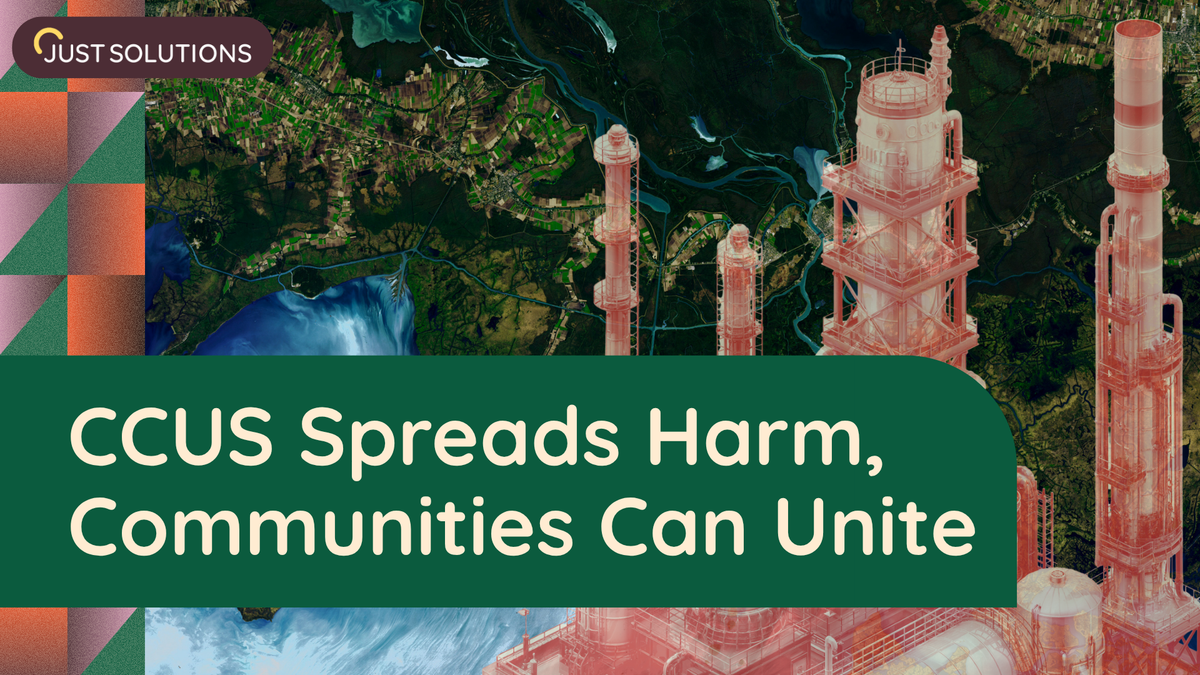
CCUS Spreads Harm, Communities Can Unite
As I document in detail in my new report, the LCEC complex was in fact one of three new blue ammonia plants being developed nearly side-by-side along the Mississippi River in southwest Ascension Parish. Two of the three new plants are still moving forward—CF Industries Blue Point in Modeste and Clean Hydrogen Works’ Ascension Clean Energy a few miles downriver outside Donaldsonville. Together, the two plants will add a permitted pollution load of nearly 2000 tons per year of criteria air pollutants, volatile organic compounds, and toxic air emissions, and an estimated 6.3 million metric tons of additional CO2 emissions. (A significant share of the CO2 emissions could be captured and sequestered if, in contrast to the historical track record, the projects’ CCUS operations prove to be highly effective.) The local pollution is regulated at the facility level, but the impact of permitted emissions is cumulative on top of existing burdens borne by local residents who are disproportionately people of color and low-income households living in one of America’s most polluted counties.[1]
According to EPA’s Toxics Release Inventory (TRI), as of 2024, Ascension Parish already ranked first among US counties for point source toxic air emissions from all industrial facilities reporting and third among counties for combined toxic releases (air, water, and land) from chemical production facilities, with more than 23 million lb reported. Ascension Parish also ranks first among all US counties specifically for point source ammonia emissions, largely because it is already home to the world’s largest ammonia production complex, CF Industries Nitrogen. In 2024, the decades-old complex ranked first in the nation for point source toxic air emissions. According to the EPA’s Greenhouse Gas Reporting Program, it is also the nation’s third largest climate polluter among all reporting facilities other than power plants, with combined greenhouse gas emissions (both carbon dioxide and nitrous oxide) of nearly 9.5 million metric tons in 2023. For context, this is nearly 80 percent more than the second-ranked climate polluter in the chemicals sector, Formosa Plastics in Point Comfort, Texas.
The LCEC collapse puts a dent in blue ammonia’s pollution load and contribution to cumulative impacts in Ascension Parish, but the rise of grassroots resistance in stopping the project is the most important development as communities face the growing threat of CCUS-adapted chemical and fuel production facilities in the region. Notably, much of the public opposition and related organizing was focused on the LCEC’s proposed CO2 pipeline and underground storage system. The pipeline was set to be routed near a primary school and residential neighborhoods, traversing east of the production plant and extending more than 35 miles into neighboring Livingston Parish. The CO2 would be buried in a sprawling complex of 18 injection and monitoring wells to be built under Lake Maurepas, a 90-square-mile estuarine tidal lake system beloved for sport fishing and recreation in the southeast corner of the county. Incensed by the threat to their lifeways and livelihoods, residents in Livingston Parish, a white-majority (83 percent) and very right-leaning (+69 for Trump in 2024) county if there ever was one, came together vocally in the public process and fought back. Responding to this opposition and other local flashpoints, in October 2025, Louisiana Governor Jeff Landry took the unprecedented step of issuing an executive order that imposed an indefinite moratorium on new CO2 storage permits and imposed specific new guidelines and standards for processing existing applications.
Landry’s moratorium, however, did not stop CF Industries from breaking ground on its Blue Point project in Modeste just two months after the LCEC collapse. Under a mandatory ("Trump speed") permitting deadline set by the White House for fertilizer projects, first announced in May, Blue Point’s air permit was finalized by the Louisiana Department of Environmental Quality (LDEQ) in early July. On August 26th, Louisiana policymakers stood alongside Secretary of Agriculture Brooke Rollins and other Trump Administration officials at the Blue Point groundbreaking. The plant has been renamed Blue Point One and claims the mantle of “world’s largest ammonia plant upon completion.” Its production capacity is estimated to be 1.4 million metric tons per year, with CO2 emissions of 2.3 million metric tons per year and an estimated carbon capture rate of 98 percent. The 45Q subsidies will potentially total more than $2.3 billion under current policy.
Compared to the LCEC, Blue Point One’s development is buttressed by what seems to be a more palatable transport and storage plan. In 2025, Blue Point secured a 25-year CO2 offtake contract with 1PointFive—Occidental Petroleum’s CCUS subsidiary—which will transport (via a dedicated 50-mile pipeline) and store the facility’s CO2 emissions in its Pelican Sequestration Hub in northeast Livingston Parish. In stark contrast to Air Products’ nightmarish storage plan for Lake Maurepas, the Pelican Hub will operate inside a 30,000-acre parcel of managed forest land leased from the Weyerhaeuser Company, with a capacity of 5–6 injection wells storing 6 million tons of CO2 per year. Storage permits for two of the injection wells are currently pending with LDEQ.
Although Blue Point One is moving forward, community advocates are still fighting back. In early September, Rural Roots Louisiana and Louisiana Bucket Brigade, with support from the Environmental Integrity Project, filed a Petition for Objection to the EPA. The petitioners request that the EPA object to the project’s LDEQ air permit because it fails to assure compliance with all applicable requirements of the Clean Air Act.
Why Blue Point One remains on track amid current economic headwinds while the LCEC collapsed is a question CCUS finance analysts surely will study more closely. The more political question of why Air Products thought it could build an eighteen-headed carbon storage monster in the middle of Lake Maurepas, a beloved and proudly South Louisianan boating and fishing mecca, is perhaps easier to answer: they mistook a mostly Republican or right-leaning community for one that would be passive in a fight against industry. The battlefield, though, is much broader, because the worst industrial impacts in the CCUS buildout—those that most directly affect people’s health—will be felt in places like Donaldsonville, where the new “low-carbon” chemicals and fuels will be produced.
CCUS’ extended chain of operations, from point-source capture to ever-expanding pipeline networks to back-end deep saline storage, could present a unique opportunity for organizing across community lines and the race and income divides that have continued to plague post-Jim Crow Louisiana politics and economic development. CCUS is clearly a common threat to both white and Black communities across South Louisiana.
According to the EPA’s EJ Screen facility reports, the population living within a three mile radius of either Blue Point or Ascension Clean Energy are, respectively, 81 and 65 percent people of color and 63 and 28 percent low-income. The Oil & Gas Watch database includes demographic data from the EJ Screen facility reports. ↩︎